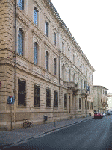
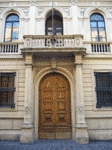
The
University Library of Pisa was opened to the public in 1742 in the rooms of Via
Santa Maria sotto la
Specola. The original core, consisting in great part of the
private library of the jurist Giuseppe Averani, was enriched through the accessions, in 1757, of the library
owned by the erudite Anton Francesco Gori (approximately 6,000 volumes) and, in
1771, at the initiative of Grand Duke Pietro Leopoldo of Lorraine, by many
double volumes from the Biblioteca Mediceo-Palatino-Lotaringia. In 1783 the
University Library received an abundant collection of books from the
Camaldolese Monastery of San Michele in Borgo, which had been enriched by the
mathematician Father Guido Grandi. The Grandi manuscripts are the most
interesting part of the collection, containing writings on hydraulics,
mathematics, physics and mechanics. Of special interest is the correspondence,
which includes some 4,000 letters exchanged among the Pisan mathematician and
illustrious correspondents such as Alessandro Marchetti, Antonio Magliabechi,
Eustachio Manfredi, and Antonio Vallisneri.
Moved
to the Palazzo della Sapienza in 1823, the Library was again significantly
enlarged under the direction of the astronomer Giuseppe Piazzini. Part of this
very conspicuous heritage consists of
letters by Galileo Galilei and other illustrious scientists from the
University of Pisa, in addition to various relics and the library of the
ancient Botanical Gardens. Noteworthy is the important group of manuscripts by
the Egyptologist Ippolito Rosellini, who was also director of the Pisa Library
from 1835 to 1843.
La Sapienza welcomed the scientists who
attended the First Congress of Italian Scientists (1839), held at the initiative
of Luciano Bonaparte and sponsored by Grand Duke Leopoldo II. On that occasion
a statue of Galileo Galilei, sculpted by Paolo Emilio Demi, was inaugurated; it
now stands in the historic Aula Magna. Noteworthy among the Galilean relics is
a 19th century plaster bust of Galileo and a painting by Antonio Caimi (1946)
representing the Pisan scientist presenting his telescope to the Venetian
Senate, donated to the University Library by the Prefect Luigi Torelli on the
occasion of the third centennial of Galileo's birth, celebrated at Pisa in
February 1864.
